
Native American Racism in the Age of Donald Trump – The New Book from Darren R. Reid
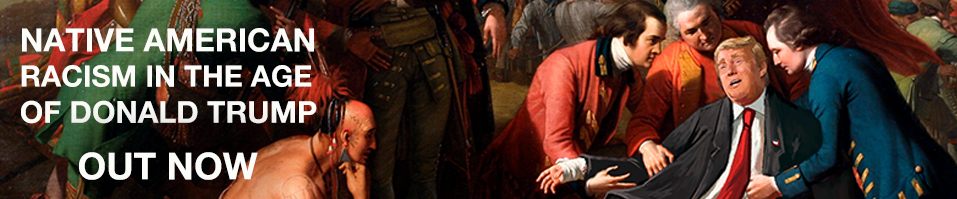
The last few years have certainly tumultuous. Historians, political commentators, and sociologists will be writing about the Trump era for decades to come. But one of the most fascinating aspects of this period is, I believe, the ways in which Trump, his administration, and his supporters have intersected with Native American lives. Indeed, it was noticing the (sometimes) unique ways in which these entities interacted with Indian Country that inspired this book. From honouring Navajo Codetalkers at the Whitehouse, to attacking casino-owning bands who had outperformed him in the 1990s, Trump (and those who surround and support him) seem deeply, surprisingly connected to Native American issues. In the Trump era, racism against Native Americans has been amplified and discourses have become toxic. In this book I set to out to demonstrate the historic roots and socio-cultural forces that have led to this moment and the types of racism we have seen in the recent past and, in all likelihood, will continue to see going forward.
The book breaks down as follows:
Chapter One: Introduction – in the opening part of the book, I lay out my case for Trump and his enablers’ deep interest in Native Americans. It considers the cultural significance of Trump’s honouring of Navajo codetalkers at the Whitehouse as well as the apparent importance of Andrew Jackson’s (perceived) legacy on Trump and his advisors.
Chapter Two: Trump Versus Indian Country – this chapter specifically explores Trump’s personal relationship with Native Americans. A large part of its focus is upon his failures in the gambling industry (in the 1990s) and his attempts to undermine, delegitimise and, ultimately, control Native American casinos (and identities). It traces Trump’s relationship from his time in the gambling space through to his presidency, with particular attention paid to his response to the Idle No More campaign. For Trump, his relationship with Native Americans has a long, contentious history rooted in gambling and business failures, essential aspects of which he carried directly into the Oval Office.
Chapter Three: Memory and White Victimhood – this chapter is framed by an incident in which teenagers from the Covington High school confronted a Native American elder. It is particularly concerned with the online discourse and anti-Native American racism that emerged in that incident’s aftermath. It does this by arguing that the radicalisation of anti-Native American views can be traced to (what is now) the mid-west in the late 18th century. It traces how the (perceived) memory of violence in this region created an oral tradition which would come to deeply inform later generations. It traces memories of violence, from the wars in which they were generated through to the veneration of this place/time in the mid-20th century as a form of mass entertainment, specifically, the celebration of characters such as Daniel Boone.
Chapter Four: Race and Identity – this chapter explore notions of identity in detail, particularly the contested nature of certain Native American identities. It is framed by a discussion of Elizabeth Warren and her claims of an indigenous identity. It considers how problematic these claims are; as well as Trump’s exploitation of them. It explores the history of ambiguous Native American identities and the cultural appropriation. It considers the ways in which white peoples have not only taken indigenous identities for their own ends, but the ways in which indigenous peoples, particularly those with African heritage, have had theirs denied. It traces a history of this phenomenon, considering provocative examples, such as that of Chief Buffalo Child Longlance, who adopted a Blackfoot identity to escape the prejudices of Jim Crow America. It also traces the changes in how Native Americans have been depicted in popular entertainment, turning them from violent outsiders into aspirational “others”.
Chapter Five: Epilogue – Trump’s America does not exist in vacuum. The United States fits into a much broader continent-wide engagement with indigenous peoples. From Jair Bolsonaro’s Brazil to Evo Morales’s Bolivia, to Justin Trudeau’s Canada, the United States is one part in a much larger system that modern Native and Indigenous Americans must constantly navigate.
Native American Racism in the Age of Donald Trump: Historical and Contemporary Perspectives is available now from Palgrave. Click Here to order your copy.
Leave a Reply